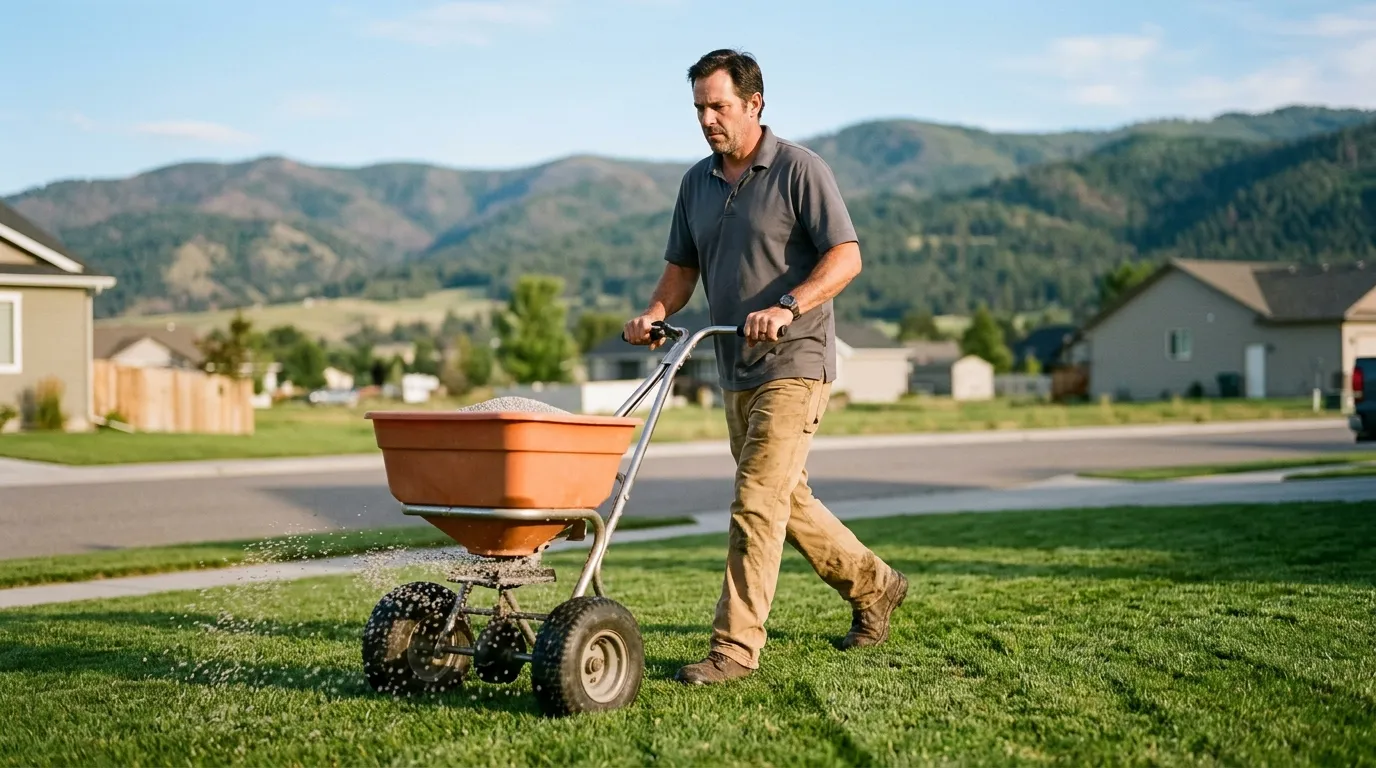
Early Spring Awakening
Early spring weed barrier that locks out crabgrass and foxtail before seeds sprout, combined with gentle slow-release root food to wake up turf and spot treatment for stubborn early broadleaf weeds.
Maintaining an emerald green, weed-free lawn in Southwest Idaho requires a seasonal program built specifically for the high desert. Between summer heat yellowing grass despite daily watering, rock-hard packed dirt that repels water, and painful goatheads digging into kids' feet and dog paws, generic store-bought fertilizer fails. Discover how independent local contractors deliver healthy turf and perimeter spider protection in one coordinated visit.
Commercial broadcast fertilization, goathead pre-emergent, and foundation perimeter spider defense across Ada & Canyon County.
The Treasure Valley operates in a high-desert microclimate receiving just 11.7 to 12.2 inches of annual rainfall, with summers routinely exceeding 100°F. Native soils throughout Boise, Meridian, Nampa, Caldwell, and Eagle are predominantly heavy silt loams and alkaline clays with a pH ranging from 7.5 to 8.2, frequently bounded by a concrete-hard layer of packed dirt beneath the root zone.
This tough alkaline dirt causes widespread summer heat yellowing and washed-out turf. Even when watered daily, high-pH dirt prevents grass roots from absorbing iron, leaving lawn blades pale, streaky, and yellow instead of lush green. Rather than burning the lawn with excessive nitrogen, independent operators incorporate fast-acting liquid iron boosters and granular soil conditioners to release locked nutrients and restore vibrant green color.
Most Treasure Valley subdivisions rely on secondary pressurized irrigation diverted from the Boise River system (New York Canal, Ridenbaugh Canal, and Boise Project Board of Control). Water is turned on between mid-April (April 10–15) and shut down in early to mid-October. Standard 6-round programs are synchronized precisely with this irrigation window, ensuring fertilizer and pre-emergent applications can be watered in before canal lines drain.
Standard big-box store fertilizers do not fix high-desert yellowing. Local contractors utilize specialized liquid iron boosters and soil conditioners that help roots absorb moisture and iron directly, keeping grass green even through 100°F heat.
While older properties feature thirsty Kentucky Bluegrass, our overseeding programs introduce deep-rooting Turf-Type Tall Fescues (TTTF) that root 2–3 feet deep, cutting summer irrigation demands by 25% while resisting drought stress.
Annual core aeration pulls 2 to 3-inch plugs of packed dirt, breaking through rock-hard soil so sprinkler water soaks into deep roots instead of pooling on top and running off into street gutters.
Every application is calibrated for seasonal high-desert growth triggers, moisture windows, and active weed germination cycles.
Early spring weed barrier that locks out crabgrass and foxtail before seeds sprout, combined with gentle slow-release root food to wake up turf and spot treatment for stubborn early broadleaf weeds.
Selective post-emergent broadleaf application targeting dandelions, white clover, and thistle using targeted three-way herbicides. We integrate fast-acting liquid iron boosters and soil conditioners that bypass tough alkaline dirt, restoring deep emerald color without scorching the grass or triggering wild surge growth.
High-desert summer heat (exceeding 100°F) demands zero-burn, polymer-coated slow-release nitrogen. Includes targeted surface insect controls against damaging billbug grubs and sod webworms, paired with soil surfactants to maximize water penetration from secondary canal irrigation.
Targeted broadleaf cleanup eradicating heat-thriving spotted spurge, field bindweed, and late-season weeds. High potassium formulation fortifies turf cellular walls against drought stress, wear, and disease as extreme heat begins to taper.
Commercial core aeration extracting 2–3 inch soil plugs relieves heavy clay soil compaction and dirt packed down like concrete beneath the lawn. Followed by slit seeding or broadcast overseeding with drought-hardy Turf-Type Tall Fescue (TTTF) and Kentucky Bluegrass blends plus starter nutrition.
Heavy late-season nitrogen application absorbed directly by grass root systems before the ground freezes (median Treasure Valley freeze date: October 27). Coordinates smoothly with sprinkler line blowout before winter dormancy to ensure an early, vigorous spring green-up.
Puncturevine (*Tribulus terrestris*), universally despised throughout Southwest Idaho as "goatheads," is classified as an official noxious weed under Idaho Code Title 22 Chapter 24. These creeping annuals produce sharp, woody burs capable of puncturing bicycle tires, penetrating heavy work boot soles, and causing agonizing wounds to pets' paws.
A single plant produces hundreds of burs containing seeds that remain viable in Treasure Valley alkaline soil for 3 to 7 years. Mowing only spreads the seeds. Successful eradication requires:
From the Boise Foothills to rural subdivisions in Nampa, Caldwell, and Kuna, goatheads thrive on newly disturbed construction ground. Community irritation is so intense that Boise hosts an annual community "Goathead Fest" festival pulling thousands of pounds of weeds.
Independent lawn care contractors incorporate dedicated goathead pre-emergent and post-emergent selective treatments into spring and early summer service visits.
Save money and eliminate scheduling headaches by bundling structural pest defense with your scheduled turf fertilization.
The applicator treats your full turf acreage with granular fertilizer, post-emergent broadleaf herbicides, and iron micronutrients.
While on site with commercial power rigs, the technician sprays a continuous micro-encapsulated liquid barrier 3 feet up your foundation stem and 3 feet out onto landscape mulch.
This dual perimeter intercepts wandering hobo spiders, black widows, elm seed bugs, and field mice before they ever breach basement window wells or foundation weep holes.
All partner applicators hold active Idaho State Department of Agriculture (ISDA) commercial pesticide applicator licenses across Category OH (Ornamental Herbicide), Category II (Agricultural), and Category Structural Pest Control.
Independent lawn care and spider defense contractors are available across all major Ada and Canyon County municipalities.
Submit your details below to request a free estimate from an independent Treasure Valley turf specialist.